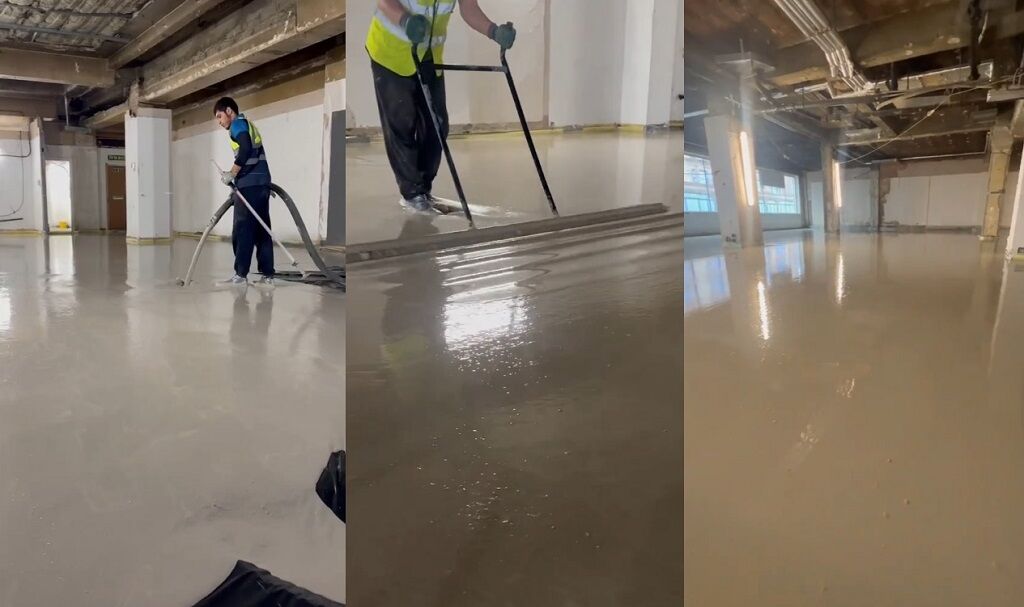

What Is Self-Levelling Concrete?
Self-levelling concrete is a polymer-modified cement. This form of modified concrete is smooth, with high fluidity, allowing for ease of placement, trowelling, feathering, and finishing. It is suitable as a base for tiles, carpet, vinyl, parquetry, timber flooring, or as a stylish floor in its own right.
Concrete Grinding is required before self-levelling concrete if you have previously had paint, epoxy, waterproofing, magnesite, vinyl, linoleum, tiles, or glued carpet floors.
Self-levelling concrete can be a fast, cost-effective solution to the problem whenever you need to repair, smooth, or raise a floor.
Self-levelling concrete is a cementitious mixture much like concrete. But unlike concrete, it flows more easily and sets up much faster. The product is mixed with water, pumped or poured into place, and spread evenly with a gauge rake. Once it’s spread out, it continues to flow evenly and levels itself out
The term self-levelling concrete was coined in the United States by ARDEX, Inc. in 1978 in reference to their first Self-levelling product, ARDEX K 15 Premium self-levelling concrete Underlayment. The term was used to differentiate it from traditional concrete, which is typically stiffer and requires more labour to get into place and finish with a trowel.
Self-levelling concrete has high flow characteristics and, in contrast to traditional concrete, does not require the addition of excessive amounts of water for placement. Self-levelling concrete is typically used to create a flat and smooth surface with a compressive strength similar to or higher than that of traditional concrete before installing interior floor coverings.
You can pour self-levelling concrete or Self-levelling overlays over concrete surfaces you didn’t think were salvageable, saving time and money. It’s faster and easier than pouring new concrete
Self-levelling concrete has increased in popularity as the need to replace old systems, such as Magnesite Flooring, has become more and more urgent because magnesite damages the concrete slab and can cause Concrete Cancer.
Depending on the product, it may be smooth and flat within 1-2 hours.
In about 6 hours, it may be completely hardened and ready for use.
Depending on the flooring material being installed on top. Self-levelling concrete can be used as an underlayment for tile, carpet, or other floor coverings. Self-levelling concrete can be poured as thin as a quarter of an inch, just enough to smooth out small imperfections if that’s all you need. But if the concrete floor has low spots and needs to be smoothed, even more, it can be poured as thick as an inch and a half without adding aggregate and 5 inches with the addition of aggregate (though make sure you follow all manufacturers’ guidelines).
Self-levelling concrete works especially well with radiant heating installations because it easily flows around the tubing. The thicker Floor Levelling compounds that must be troweled to achieve a proper finish can’t do this.
Self-levelling concrete is a compound that can be used on a concrete slab or a wood subfloor and can be effective with any dips in the floor. These Self-levelling compounds are similar to concrete and typically come in large bags of powder. The powder should be mixed with water to create a thick paste, and you can spread it over the floor, and it will automatically level out in the effective areas. But it may also need to be raked into areas.